


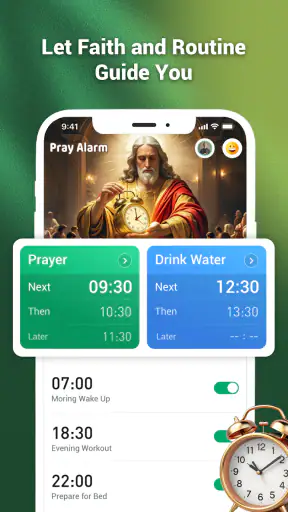


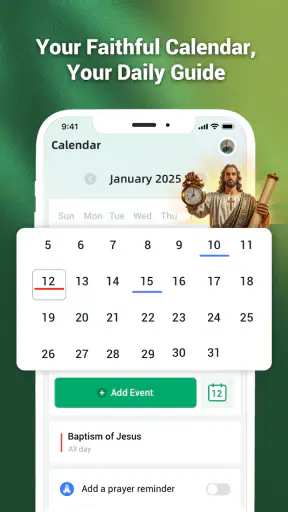
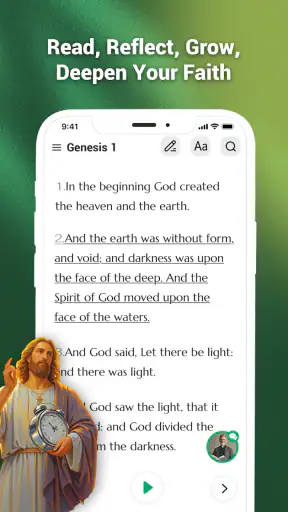

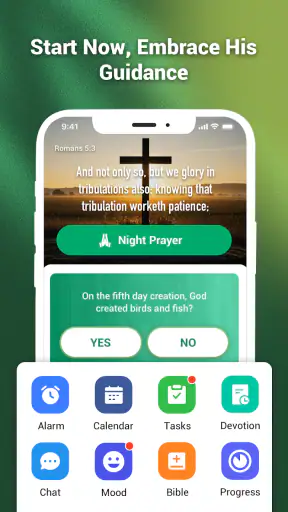

I tried Pray Alarm, Calendar & Bible as a daily faith companion rather than treating it like another calendar or alarm utility. That distinction matters. Its main idea is to put prayer prompts at the point where a normal alarm would interrupt your routine, then surround that reminder with Bible reading, a Christian calendar, quizzes, and other spiritual-growth tools. In my experience, the appeal is less about replacing every religious resource on your phone and more about making a small pause easier to remember.
Developed by WOOMBIT, this free Lifestyle app is aimed at people who want a lightweight Christian routine on Android. It is available for users aged Everyone, works from Android 8.0 onward, and has reached more than five million installs. Its current version is 1.9, while the overall response has been strong: a 4.7 average from roughly thirty-eight thousand ratings. Those figures suggest that the central reminder-based approach connects with a broad audience, although popularity alone does not tell you whether its rhythm will suit your personal habits.
Why the prayer alarm is the feature that changes the experience
The most important capability here is not the Bible section by itself. A Bible reader is easy to find, and a standard calendar can already organize dates. The distinctive idea is using an alarm as a deliberate cue for prayer. That turns a spiritual intention into something attached to an existing behavior: waking up, beginning work, taking a break, or preparing for sleep.
I find that approach more practical than relying on motivation alone. Many people sincerely intend to pray during the day, but intentions compete with messages, appointments, chores, and fatigue. A scheduled prompt gives the practice a visible place in the day. It does not make prayer meaningful automatically, of course, but it can stop the habit from disappearing into the background.
The useful mental shift is to treat each alert as a doorway rather than a command. If I respond to it by taking a quiet minute, opening a passage, or simply remembering what I wanted to bring into prayer, the reminder has done its job. If I create too many alerts, the same feature can become noise. The app works best when the schedule reflects real moments in my life instead of an idealized routine that I will ignore after a few days.
That is also where this app differs from the usual alternatives. A normal alarm is excellent at getting me out of bed, but it has no spiritual context. A general habit tracker can mark a task complete, yet it may make prayer feel like another productivity checkbox. A standalone Bible app usually gives me more depth for reading and study, but it does not necessarily place that material beside a timed interruption. Pray Alarm, Calendar & Bible sits between those choices: less specialized than a full study tool, but more intentional than a generic reminder.
Building a routine that feels believable
When I set up a prayer reminder, I would start with one dependable point in the day rather than filling the schedule immediately. Morning is an obvious choice, but it is not always the best one. Someone with a rushed commute may find a short evening pause more realistic. A parent might prefer the quiet after children are asleep. The app’s value depends on matching the reminder to a moment when I can actually stop, not merely to a time that looks spiritually impressive on a schedule.
A practical workflow is to connect the alert with one nearby action. After waking, I might read a brief Bible passage before checking notifications. During a lunch break, I could use the prompt as a reset before returning to work. At night, the reminder could become a review of the day rather than another demand. The Christian calendar can add seasonal or observance-related context, while the quiz can help me revisit what I have read when I want something more active than passive scrolling.
This combination gives the app a useful progression. The alarm starts the moment, the Bible provides material for reflection, the calendar adds a sense of time within Christian observance, and the quiz can reinforce memory. I would not use every part every day, and that is fine. The strongest routine is usually selective. Trying to consume all the available tools at every reminder would make a simple pause feel like a lesson plan.
One less obvious benefit is that the alarm can serve people who are not looking for a long devotional session. A reminder does not have to lead to twenty minutes of reading. It can mark a short prayer before a difficult conversation, a moment of gratitude during a busy shift, or a quiet pause before sleep. That flexibility makes the app more approachable than resources designed around lengthy study sessions.
What using the Bible and calendar adds
The KJV Bible element gives the prayer prompt a traditional textual anchor. Readers who already prefer the King James Version may appreciate having that wording close at hand instead of moving between a reminder and a separate reader. For someone who does not naturally reach for the KJV, the experience may feel more specific and less adaptable than a Bible app offering many translations. That is an important choice, not a minor detail.
I see the Bible component as most useful when I decide in advance what kind of reading belongs beside a particular reminder. A morning prompt can lead into a short passage, while an evening prompt can encourage slower reflection. The app is easier to use when the reading supports the purpose of the alert rather than becoming an endless library to browse. That is a workflow insight I would have missed if I judged it only by the presence of a Bible section.
The Christian calendar serves a different purpose. It is not simply another list of appointments; it can help place personal prayer within the wider rhythm of Christian dates and observances. That makes it valuable for users who want their routine to acknowledge more than ordinary weekdays. At the same time, people who need a detailed family, work, or school planner should keep their regular calendar. This app is better understood as a faith-focused companion than as a replacement for a full scheduling system.
The Bible quiz is a welcome change of pace, especially when I want to check whether I remember a passage or theme instead of just reading it once. Quizzes can also make the app more approachable for households or small groups looking for a simple conversation starter. I would not treat quiz performance as a measure of spiritual growth. Its real value is engagement and recall, not turning faith into a score.
A realistic day with the app
Imagine a user who starts work early and often reaches for the phone before getting out of bed. A prayer alarm placed around that first quiet moment can redirect the habit before social feeds take over. The user might read from the KJV Bible, offer a brief prayer, and then continue with the morning. A second, less frequent reminder could appear around a natural break, giving the person a chance to pause rather than waiting until the day is already over.
Later, the Christian calendar may explain why a particular date matters within the user’s faith tradition. On a quieter evening, the Bible quiz can provide a small review activity. None of these steps needs to become a formal study program. The strength is the connection between ordinary transitions and spiritual attention. The app makes those transitions easier to notice.
For me, the key is restraint. I would begin with one reminder, use it consistently, and only add another after the first feels natural. I would also keep the alert tied to a clear intention: gratitude, guidance, confession, intercession, or reading. That prevents the notification from becoming a vague interruption. This kind of setup is a more meaningful test of the app than simply opening each feature once.
The friction and trade-offs to consider
The biggest trade-off is focus. Pray Alarm, Calendar & Bible brings several related tools together, but that also means it is not as specialized as the best standalone option in each area. Someone seeking extensive Bible study, detailed notes, broad translation support, or advanced research tools may prefer a dedicated Bible application. Someone managing appointments and shared schedules will still need a conventional calendar. Someone who wants only a silent prayer checklist may find the broader package more than necessary.
The KJV focus is another genuine dividing line. It will feel reassuring and familiar to readers who already choose that translation. Others may find the language less immediate, particularly if they are new to Bible reading or usually use a modern translation. I would recommend deciding that question before building a routine around the app, because the reminder system cannot compensate for a reading experience that does not suit you.
There is also a behavioral risk with any alarm-centered tool: alert fatigue. A reminder that arrives at an inconvenient time can be dismissed repeatedly, and repeated dismissal teaches me to ignore the app. The solution is not necessarily more customization; it is a smaller, more honest schedule. If a prompt interrupts meetings, commuting, childcare, or sleep, it is poorly placed no matter how good the underlying idea is.
Another limitation is emotional rather than technical. A scheduled notification can encourage consistency, but it cannot replace community, pastoral guidance, personal study, or genuine willingness to pray. Users looking for a complete spiritual program may be disappointed if they expect the app to provide all of those things. I would use it as a prompt and resource shelf, not as a substitute for relationships or deeper formation.
Because the app is free, it is easy to try without making a financial commitment. That lowers the barrier for curious users, families, and people rebuilding a routine. Still, free access should not be confused with a perfect fit. The right question is whether its particular blend of prayer alarms, KJV reading, calendar context, quizzes, and growth tools supports the way you already live.
Who benefits most from this focused approach
I think the best match is a Christian user who already owns a phone, wants regular prayer cues, and prefers having several connected resources in one place. It is especially suitable for someone who says, “I want to pray more consistently, but I keep forgetting.” The app addresses that specific problem directly instead of assuming that a large library alone will create a habit.
It can also work well for beginners who want a gentle starting point. The alarm gives structure, the Bible offers a place to begin, and the quiz can make learning less intimidating. I would encourage a beginner to keep the first routine short and repeatable. A small practice that survives busy days is more useful than an ambitious schedule that disappears after the first week.
Families may find the quiz and calendar useful for shared discussion, while individual users may appreciate the privacy of a personal reminder. People who already have a strong devotional system can still use the alarm as a simple cue, but they may not need the extra tools. In that case, a basic alarm paired with a preferred Bible resource could be more efficient.
I would be cautious about recommending it to someone who needs a general-purpose calendar, a broad translation library, or advanced study features. It is also not the right choice for a user who dislikes notifications or wants a completely self-directed reading experience. The app’s identity is built around prompts, and that will feel supportive to one person and intrusive to another.
My final take after living with the idea
What I like most is the app’s clear answer to a common problem: remembering to create space for prayer in an already crowded day. The prayer alarm is not a gimmick when it is used thoughtfully. It changes the phone from a source of constant distraction into a cue for a deliberate pause. The surrounding KJV Bible, Christian calendar, quiz, and spiritual-growth tools make that pause easier to continue when I want more than a notification.
My advice is to start modestly, choose a time you genuinely control, and decide what you want to do when the alert appears. Read a passage, pray briefly, or use the moment to reflect; do not turn every reminder into a demanding assignment. If the KJV suits you and you want faith-oriented prompts rather than a generic productivity system, this free Lifestyle app is worth trying. If you need a full Bible study platform or a complete everyday calendar, I would choose a specialized alternative and use this only for its central strength.
Overall, I see Pray Alarm, Calendar & Bible as a practical habit companion rather than an all-in-one answer to Christian life. Its strongest contribution is simple and useful: it helps give prayer a place in the day. That is enough to make it meaningful for the right user, provided the schedule stays realistic and the app remains a support for personal faith rather than a substitute for it.


